Top 15 Best Entry Level Thermal Scope That Will Blow Minds!
Choosing the best entry level thermal scope can be tricky for anyone starting out, especially after dealing with units that produce blurry images or have unreliable battery life. Many scopes in the entry-level range struggle with detecting heat signatures clearly beyond a few hundred yards, making it frustrating during nighttime tracking or hunting.
Users often find the controls complicated, which adds to the challenge of quickly aiming and identifying targets.
The difference between a practical entry-level thermal scope and a less effective one usually comes down to resolution and refresh rate. A resolution around 320×240 pixels is common and offers enough detail for most entry-level needs, while higher refresh rates, typically 30 Hz, ensure smoother tracking of moving objects. Durability also matters, so scopes built with sturdy materials and water resistance up to at least IP67 protect the device outdoors.
Compact size and simple button layouts contribute to easier handling, letting users focus on their task without fumbling through complicated settings.
Need a Quick Check?
| Image | Product | Price |
|---|---|---|
Our Top Picks 1  | AGM Rattler V2 Scope | Check Price |
Our Top Picks 2  | TOPDON TS004 Monocular | Check Price |
Our Top Picks 3  | RIX STORM-S3 384 Scope | Check Price |
Our Selected Top 15 Entry Level Thermal Scope Worth Buying
This list features carefully chosen entry level thermal scopes designed for various outdoor and tactical needs. Each review highlights performance, ideal users, and key advantages and drawbacks, helping readers identify the best fit based on their specific requirements and experience levels.
1. AGM Global Vision Rattler V2 Thermal Imaging Scope
AGM Global Vision Rattler V2 Thermal Imaging Scope works best for those seeking quick target acquisition in entry-level thermal scopes. It suits people who need a reliable option for fast-moving targets and close- to mid-range hunting with clear visuals.
Setting up the scope is straightforward with its Picatinny mount designed for rifles, making it easy to attach and adjust. The 2.5x base magnification combined with a wide 9.3-degree field of view helps you spot targets quickly, especially in dense cover or active situations. Having two rechargeable batteries ready adds convenience for longer sessions without worries about power.
Performance-wise, the scope shines with crisp targeting at magnifications up to 20x and runs for 11.5 hours on a single charge, which holds up well during extended outings. Its build feels solid and practical, but some users note the eye relief distance at 45 millimeters may require adjustment for comfort.
The biggest praise is its fast targeting and wide view; the common drawback concerns the somewhat limited objective lens size for distant clarity.
The scope receives strong praise for its quick target acquisition thanks to the wide field of view and reliable battery life allowing all-night use. A frequent complaint is that the 19 millimeter objective lens can make distant objects less detailed, which might restrict some users’ expectations in long-range scenarios.
Those who need a thermal scope focused on tracking close- to mid-range, fast-moving targets will find this model suitable and dependable. People wanting sharper distant images or longer eye relief might prefer to explore other options before committing.
Pros
- Wide field of view aids quick target tracking
- Runs up to 11.5 hours on one charge
- Includes two rechargeable batteries for backup
- Easy rifle mounting with Picatinny system
Cons
- Objective lens size limits distant clarity
- Eye relief may feel short for some users
| Specification | Details |
|---|---|
| Magnification Minimum | 2.5 x |
| Magnification Maximum | 20 x |
| Objective Lens Diameter | 19 millimeters |
| Field Of View | 9.3 degrees |
| Eye Relief | 45 millimeters |
| Mounting Type | Picatinny Mount |
2. TOPDON TS004 Thermal Imaging Monocular
Using the TOPDON TS004 Thermal Imaging Monocular feels straightforward and reliable, especially for anyone stepping into thermal scopes. It suits outdoor enthusiasts who want clear, detailed thermal images without complicated setups. Its single biggest strength is the sharp thermal resolution paired with long battery life, so you get quality imagery and plenty of use time.
Getting started is simple, thanks to the manual focus and a familiar reflex finderscope. Day-to-day, the battery lasts up to 11 hours, which means no constant recharging during extended outings. Connecting wirelessly to your phone through the dedicated app makes it easy to monitor what you’re seeing live, adding convenience for scouting or spotting in real time.
The thermal monocular delivers vivid images through its 256×192 IR resolution and keeps visuals smooth with a 50Hz refresh rate. Built with a monocentric eyepiece lens and a solid 13mm focal length, it feels durable and comfortable to hold.
The standout praise is its image clarity, while the main complaint revolves around the need for manual focus adjustments during use.
The strongest point is the vivid thermal images thanks to high IR resolution and smooth refresh rate, helping users spot even fine details. The most frequent downside mentioned involves the manual focus, which needs regular tweaking to keep subjects sharp as you move or change distances.
People wanting a reliable, long-lasting thermal scope with uncomplicated connectivity will appreciate its straightforward setup and clear display. Those who prefer autofocus or wider fields of view for broader scanning might look for other options better tailored to those needs.
Pros
- Clear 256×192 thermal resolution
- Up to 11 hours battery life
- Wireless live monitoring via smartphone
- Compact monocentric lens design
Cons
- Requires manual focus adjustments
- Limited field of view at 13.5 degrees
| Specification | Details |
|---|---|
| IR Resolution | 256×192 |
| Battery Capacity | 5000mAh |
| Refresh Rate | 50Hz |
| Focal Length | 13 millimeters |
| Zoom Ratio | 8x |
| Field Of View | 13.5 degrees |
3. RIX STORM-S3 384 Thermal Scope
Great for anyone starting out with thermal scopes, this model stands out for its clear imaging and solid range. Its combination of a high sensitivity detector and adjustable magnification is perfect for spotting targets at a distance without breaking the bank.
Setting up involves attaching it to a rifle with the Picatinny mount, which is straightforward and stays firmly in place. The 35mm lens and eye relief of 48 millimeters make aiming comfortable.
Adjusting magnification from 3.5x to 14x is smooth, letting you zoom in or out depending on the situation. The field of view covers a wide horizontal area, helping you scan without constantly moving the scope.
The thermal sensor provides a crisp picture even at the maximum 1969-yard distance, thanks to the RIX RET image enhancement. The build feels sturdy, and the 7.5° horizontal field of view is practical for tracking movement.
Most praise focuses on the image quality rivaling higher-end scopes, while the main drawback involves limited field of view compared to some competitors.
The image quality stands out for an entry-level scope due to RET technology, offering visibility close to more expensive models. The most common downside is a narrower field of view, which can feel tight when tracking fast-moving or multiple targets.
Hunters and shooters who want good clarity and zoom options without a high price will find this scope suitable. Those needing a wider field of view or larger lens diameter might want to look at other options.
Pros
- Clear thermal imaging at long distances
- Adjustable magnification from 3.5x to 14x
- Comfortable eye relief of 48 millimeters
- Reliable Picatinny mounting system
Cons
- Narrower horizontal field of view than some scopes
- Limited lens diameter may reduce light intake
| Specification | Details |
|---|---|
| Magnification Minimum | 3.5 x |
| Magnification Maximum | 14 x |
| Objective Lens Diameter | 35 millimeters |
| Field Of View | 5907 feet |
| Mounting Type | Picatinny Mount |
| Eye Relief | 48 millimeters |
4. RIX Storm S3 R 12um 384 Thermal RifleScope

Made with a solid construction and weighing just 0.97 pounds, the RIX Storm S3 R is designed for anyone needing reliable thermal imaging without lugging heavy gear. Its standout feature is the built-in laser rangefinder paired with a ballistic calculator, making long-range shots more accurate than many entry-level scopes.
Setting it up is straightforward thanks to the quick detach mount, which fits both rifles and handguns. Day-to-day use feels balanced given its light weight and compact size.
The 35mm objective lens offers clear thermal images, and the magnification varies smoothly between 3.5x and 14x, allowing for good target detail at different distances.
Performance-wise, the 384×288 resolution with 12μm pixel pitch delivers sharp thermal detection. The built-in laser rangefinder works precisely up to 1312 yards with an accuracy of ±1.09 yards.
The scope is made for durability and precision, but some users note the fixed reticle can’t be customized unlike other scopes in this class.
The scope’s precise laser rangefinder combined with the ballistic calculator is highly praised for boosting accuracy on longer shots. The most common drawback is the fixed reticle, which some find restricts adjusting the aiming point for different preferences.
Hunters and shooters looking for a lightweight, feature-rich thermal scope with integrated rangefinding will appreciate this model. Those wanting customizable reticles or extreme detection range might look toward other options more tailored to those needs.
Pros
- Compact and lightweight design for easy handling
- Accurate built-in laser rangefinder with ballistic calculator
- Good resolution with 12μm pixel pitch for clear images
- Quick detach mount fits rifles and handguns
Cons
- Fixed reticle limits customization options
- Detection distance impressive but may vary in real use
| Specification | Details |
|---|---|
| Objective Lens Diameter | 35 millimeters |
| Pixel Pitch | 12μm |
| Resolution | 384×288 |
| Magnification Range | 3.5x to 14x |
| Detection Distance | 1969 yards |
| Built-in Laser Rangefinder Range | 1312 yards |
5. Triton StarStrike Gen II Night Vision Scope

Easy to mount and comfortable to use, this scope suits anyone starting with thermal optics. Its biggest strength lies in the patented extendable eyecup hood that blocks out light, making the view crisp and clear. Perfect for all-day use, it adjusts easily to fit your eye just right.
Setup is straightforward thanks to the Picatinny rail system that snaps onto many platforms without needing extra rings. The adjustable eye relief ensures comfort during long sessions, and switching between day and night view requires no equipment changes.
The digital zoom adds versatility, letting you get closer to your target up to 200 yards away.
Performance lives up to its promise with a dependable 20x maximum magnification and a clear cross reticle for aiming. The tough aircraft-grade aluminum case withstands rough conditions and keeps the scope waterproof. Many find it reliable and sturdy, though some note the digital zoom may lose some detail at full range.
The scope delivers clear visuals with its high-sensitivity illuminator and keeps light leakage out, making long viewing periods comfortable and effective. Users appreciate the durable construction and ease of mounting, though some mention the digital zoom doesn’t always maintain crispness when zoomed in fully.
Anyone new to thermal scopes looking for solid functionality without complicated setup will enjoy this. Those needing the absolute best detail at extreme distances might want to explore higher-end options.
Pros
- Adjustable eye relief for comfortable viewing
- Clear target identification up to 200 yards
- Rugged, waterproof aircraft-grade aluminum build
- Simple Picatinny rail mounting, no scope rings needed
Cons
- Digital zoom can reduce detail at maximum range
- May feel a bit bulky for some users
| Specification | Details |
|---|---|
| Magnification Minimum | 5 x |
| Magnification Maximum | 20 x |
| Objective Lens Diameter | 50 millimeters |
| Field Of View | 200 yard |
| Mounting Type | Picatinny Mount |
6. RIX StormS2R 12um 256×192 Thermal RifleScope
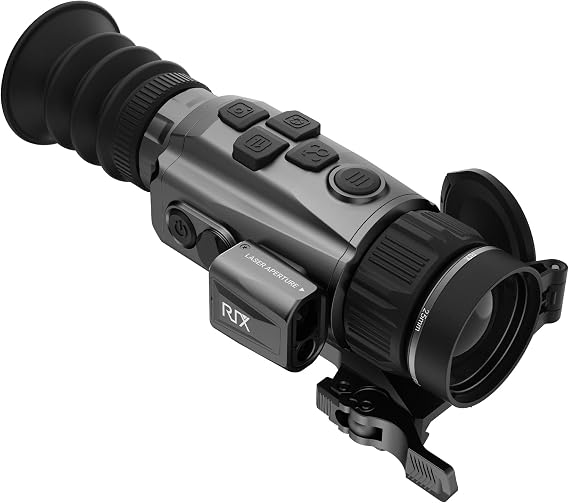
Ideal for someone stepping into the world of thermal scopes, the RIX StormS2R offers precision at a surprisingly light weight, making it easy to handle without sacrificing clarity. Its standout feature is the built-in laser rangefinder that extends your detection range well beyond typical entry-level models.
Setting it up doesn’t require much fuss, fitting neatly on any Picatinny rail. The intuitive button layout reacts with clear on-screen cues, which helps especially when wearing gloves.
Switching from 3.5x to 14x magnification feels smooth, so observing targets at various distances is straightforward and reliable.
The 256×192 resolution with a 12μm pixel pitch delivers sharp images out to over 1400 yards, making it impressive for spotting and tracking. Constructed with durable materials and weighing just under a pound, it balances solid feel and portability. A frequent point of praise is the ease of use, while the most common gripe is limited eye relief at 48mm, which might not suit all shooters.
The clear on-screen interface and easy control layout get a lot of positive notes in reviews, helping users quickly make adjustments even in cold or gloved conditions. Some mention the eye relief as a less comfortable fit depending on their shooting style or eye position.
Those seeking a thermal scope that balances weight, range detection, and user-friendly controls will find this a solid pick. People needing longer eye relief or much higher magnification might want to look elsewhere before deciding.
Pros
- Lightweight at just 0.9 lb for easy handling
- Built-in laser rangefinder up to 1312 yards
- Intuitive button interface with clear feedback
- High resolution for sharp thermal images
Cons
- Eye relief of 48mm may feel tight for some users
- Magnification maxed at 14x, limiting extreme distance views
| Specification | Details |
|---|---|
| Magnification Range | 3.5x to 14.0x |
| Objective Lens Diameter | 25mm |
| Resolution | 256×192 |
| Pixel Pitch | 12μm |
| Weight | 0.9 lb |
| Detection Distance | 1422 YDS |
7. DNT Optics HYDRA Thermal Scope

Hunting in low light or total darkness calls for reliable thermal imaging that adapts to multiple situations. Ideal for shooters who want flexibility, the DNT Optics HYDRA Thermal Scope combines three devices into one, making it especially useful when switching between handheld observation and rifle use. Its ability to switch roles easily stands out as the biggest strength.
Setting up involves mounting it using the QDM150 standard, which fits rifles snugly. It runs on two nonstandard batteries, so having spares is useful. Manual focus requires attention, but focusing is straightforward once you get the hang of it.
Day-to-day use benefits from the clip-on capability and the handheld mode, which makes it easy to scan terrain without removing it from your gear.
Performance excels thanks to a 256×192 thermal sensor with a 50fps frame rate that keeps the image smooth. The AI-enhanced super resolution boosts digital zoom clarity, making details more visible even at 4x zoom. Construction feels solid, although manual focus could be more intuitive.
The most common praise focuses on adaptability and image quality, while some note that the nonstandard batteries might be inconvenient in the field.
The adaptability to switch between standalone scope, monocular, and clip-on module earns strong positive feedback, along with clear thermal images from the high-end sensor. The common downside noted is the use of two nonstandard batteries, which can complicate power management during extended outings.
Those valuing versatility and image quality will find this scope very useful across diverse hunting and shooting setups. Users wanting simpler battery options or faster focusing might consider other models more tailored to quick changes in the field.
Pros
- Functions as riflescope, monocular, or clip-on
- AI-enhanced imaging keeps zoom sharp
- High-end thermal sensor ensures clear visuals
- Smooth 50fps refresh rate
Cons
- Uses nonstandard batteries, harder to replace
- Manual focus less intuitive for quick adjustments
| Specification | Details |
|---|---|
| Mount | QDM150 |
| Focus Type | Manual Focus |
| Power Source | Battery Powered |
| Number of Batteries | 2 Nonstandard Battery batteries required |
| Zoom Ratio | 4x |
| Focal Length Description | 25 millimeters |
8. GOYOJO G215 Thermal Imaging Monocular

Featuring a 256×192 thermal imaging sensor with a 12μm infrared detector, the GOYOJO G215 suits anyone starting out with thermal scopes wanting clear, detailed views in low light. Its standout feature is the combination of sharp thermal imagery and ease of use for spotting heat signatures at a distance.
Setup involves just inserting the included lithium polymer battery and focusing manually through the OLED digital eyepiece. Switching between six color palettes allows quick adjustments to fit different environments or preferences.
The device is handheld but also mounts on a tripod for stability, making it flexible for different outdoor situations. Pairing with a smartphone adds another layer of convenience to usage.
The camera sensor and 15mm optimized infrared lens provide clear detection and good target focus up to 4x zoom within an 11.7-degree field of view. The monocular is multi-coated for lens protection and clarity.
Reviews often praise the sharp image quality and color mode variety but note manual focus can be tricky for some users, especially in fast-paced scenarios. The overall build is compact and solid enough for casual outdoor use.
Sharp thermal images and multiple color palettes stand out as major strengths. Manual focusing receives criticism for not being as user-friendly when speed matters, which can slow down target acquisition under pressure.
Anyone exploring thermal scopes for hunting or nighttime observation will find this model reliable and versatile. Those needing faster autofocus or a wider field of view might look toward higher-end options better suited for dynamic environments.
Pros
- High-resolution thermal imaging with clear details
- Six color palette options for varied conditions
- Compatible with smartphone for added convenience
- Compact and lightweight handheld design
Cons
- Manual focus can be challenging in quick situations
- Smaller field of view limits peripheral detection
| Specification | Details |
|---|---|
| Thermal Camera Sensor | 256×192 |
| Infrared Detector | 12μm |
| Lens Focal Length | 15mm infrared lens |
| Field Of View | 11.7 degrees |
| Zoom Ratio | 4x |
| Power Source | 1 Lithium Polymer battery (included) |
9. 384×288 Thermal Scope

Hunters and outdoor enthusiasts looking for an entry-level thermal scope will find the 384×288 fits the bill with solid image clarity and smooth tracking. Its main strength lies in the clear thermal imaging powered by a 384×288 resolution and 12μm sensor, which makes spotting targets easy in low light or total darkness.
Setting up the scope is straightforward thanks to its manual focus design and fixed focal lengths, 4x for thermal and 7x for night vision modes. The 60Hz frame rate keeps the image fluid when following moving targets. Switching between thermal and night vision modes feels natural, and the 35-degree field of view covers enough ground during typical use without feeling cramped.
It performs well in capturing subtle temperature differences, helping to identify targets accurately even at a distance. The build feels solid, and focusing is quick and responsive.
Most praise centers on the high thermal sensitivity allowing precise detection, while a common complaint is the lack of mounting options, which can limit how it attaches to gear.
The 384×288 thermal scope offers impressive thermal sensitivity that helps detect subtle temperature differences clearly, making target identification reliable both day and night. Many users note the image is sharp and smooth thanks to the 60Hz frame rate. However, the absence of a mounting system can be inconvenient for those wanting quick gear integration.
People who want a straightforward thermal scope with consistent image quality will appreciate how well it performs under various conditions. Those needing adjustable zoom or ready-to-go mounting solutions might find this model less suitable and should consider other options with more flexibility.
Pros
- Clear thermal imaging with 384×288 resolution
- High thermal sensitivity at 25mK for detecting temperature changes
- Fast 60Hz frame rate for smooth image tracking
- Manual focus for quick adjustments
Cons
- No mounting type included
- Fixed focal lengths limit zoom flexibility
| Specification | Details |
|---|---|
| Resolution | 384×288 |
| Sensor | 12μm |
| Frame Rate | 60Hz |
| Magnification Maximum | 7 x |
| Objective Lens Diameter | 35 millimeters |
| Field Of View | 35 degrees |
10. GOYOJO G210 Thermal Monocular

Sharp thermal imaging at a reasonable price distinguishes this monocular for anyone starting with thermal scopes. It suits outdoor enthusiasts, hunters, or security watchers who want clear thermal views with simple operation and adjustable color settings.
Its standout strength is precise thermal detection in various lighting situations.
Setup requires just inserting the included lithium polymer battery, and it’s ready to go. Holding it feels natural thanks to the Plossl eyepiece lens, and the fixed focus makes quick spotting easy.
Six color palette choices let you adjust views easily, and the 4X zoom helps bring distant objects closer. 16GB of storage makes saving images straightforward without extra gear.
Performance matches the expectations for entry-level scopes with a 256×192 sensor enhancing thermal clarity. Built with multi-coated lenses and a sturdy design, it handles outdoor conditions well.
Reviews praise its swift and accurate detection but commonly note the limited zoom ratio and manual control as requiring some patience to master.
The 256×192 sensor delivers clear thermal detection praised for its swift and accurate imaging. The fixed focus and limited zoom require some adjustment time and might not satisfy users needing detailed long-range views. Battery-powered operation simplifies use without external wiring hassles.
Those starting out in thermal imaging or needing a straightforward handheld device will find this monocular practical and effective. People requiring higher zoom or variable focus for specialized tasks should look at other options better suited for advanced use.
Pros
- High-resolution thermal sensor
- Six selectable color palettes
- Includes 16GB storage for images
- Multi-coated lens for clear viewing
Cons
- Fixed focus limits close-up sharpness
- Limited zoom (2x) not for long distances
| Specification | Details |
|---|---|
| Sensor Resolution | 256×192 |
| Zoom Ratio | 2 |
| Field Of View | 17.5 degrees |
| Power Source | 1 Lithium Polymer battery (included) |
| Display Modes | 6 color palettes |
| Image Storage | 16GB |
11. Thermal Imaging Night Vision Scope 320×240

Thermal Imaging Night Vision Scope 320×240 works well for anyone starting with thermal scopes who needs clear heat signatures and a reliable aiming system. Its standout feature is the high-resolution 320×240 thermal camera that helps spot targets up to 100 meters away with ease.
Setting it up is straightforward, especially with its Picatinny mount that fits most rifles. The dual aiming system combining a crosshair and red laser ensures quick aiming during day or night sessions. A 3x digital zoom adds flexibility in spotting details, while the 2-inch display keeps the image sharp and easy to read during use.
Performance lives up to expectations with a smooth 50Hz refresh rate delivering real-time heat images. The aluminum alloy build feels solid and durable, backed by IP66 waterproof and dustproof ratings for outdoor use. Users often praise the clear imaging but note that the maximum 3x magnification can feel a bit limiting at longer distances.
Many appreciate the clear heat signature imaging and the accurate dual aiming system combining crosshair and red laser. Common complaints focus on the limited magnification, which some find restrictive when spotting targets beyond 100 meters. The compact display size also affects visibility under certain conditions.
People looking for a solid thermal scope that holds up well outdoors and works within medium-range distances will find this suitable. Those needing higher magnification or a larger display might want to explore other options better suited for long-range precision.
Pros
- Clear 320×240 resolution thermal images
- Dual aiming system with red laser and crosshair
- Waterproof and dustproof with IP66 rating
- Operates in extreme temperature ranges
Cons
- Limited maximum magnification of 3x
- Small 2-inch display may feel cramped
| Specification | Details |
|---|---|
| Magnification Maximum | 3x |
| Objective Lens Diameter | 9 millimeters |
| Compatible Devices | Rifle |
| Mounting Type | Picatinny Mount |
| Reticle Type | Cross centered |
12. RIX Pocket K2 Thermal Monocular

Lightweight and pocketable, this thermal monocular suits hikers and hunters who want easy carry without sacrificing detection ability. Its clear 800×600 OLED display stands out, making subtle heat differences visible in various weather conditions its greatest asset.
Setup is straightforward with a single lithium-ion battery included, and the fixed focus lens means there’s no fuss adjusting. The IP67 waterproof rating adds confidence for outdoor use.
Compatible with smartphones, it fits easily in a pocket or pack, letting you grab it fast when needed for quick thermal scans on the go.
Image quality is strong for an entry-level scope thanks to 256×192 resolution and a 50Hz refresh rate, showing fine temperature differences without delay. The construction feels solid yet very light, lighter than a smartphone, while the most frequent user downside involves its fixed focus, which can limit some distant viewing clarity.
The display delivers crisp visuals and picks up subtle temperature differences well, which users appreciate. Common complaints focus on limited clarity at long distances because of the fixed focus lens.
People who want a lightweight, easy-to-carry thermal monocular for close to medium range observations will find it ideal. Those needing adjustable focus for long-range clarity might want to consider other options.
Pros
- Highly detailed 800×600 OLED display
- Very lightweight, fits easily in a pocket
- Waterproof with IP67 rating
- Includes battery for immediate use
Cons
- Fixed focus limits distant clarity
- Single battery life may require spares
| Specification | Details |
|---|---|
| Resolution | 256×192 |
| Display | 800×600 OLED |
| Field Of View | 19.4 degrees |
| Power Source | 1 Lithium Ion battery (included) |
| Waterproof Rating | IP67 |
| Zoom Ratio | 7 |
13. RIX Pocket K3 Thermal Monocular
Great for beginners looking to explore thermal imaging without bulk or complexity, the RIX Pocket K3 offers clear images in a compact form. Its strongest point is portability combined with an impressive detection range that suits casual outdoor observation and beginner-level hunting.
Setting up is straightforward thanks to its lightweight design that fits neatly in your hand or pocket. It connects easily to tripods using the standard 1/4-20 interface for stable viewing during longer sessions.
Daily use benefits from the 2x base magnification and a wide 17.5° field of view, making it easy to spot thermal signatures without constant adjustment.
Performance delivers crisp thermal imaging with a 384×288 sensor and a 15mm lens, detecting objects up to 853 yards under the right conditions. The design feels sturdy for its size, though some have noted that image clarity can vary with environmental factors like humidity and terrain. The overall construction supports everyday outdoor activities but isn’t designed for heavy-duty or professional use.
Clear thermal imaging and portability stand out as its biggest strengths, though performance can dip in humid or complex terrains. The standard tripod mount adds stability for longer use, but the fixed 2x zoom limits close-up detail. Many reviews praise its ease of carry and clear visuals under good conditions.
Those wanting a lightweight, entry-level thermal monocular for casual observation or light hunting will find it a solid choice. Users needing more zoom power or consistent clarity across varied weather might prefer a different model better suited to advanced demands.
Pros
- Compact and pocket-friendly design
- Long detection range up to 853 yards
- Simple tripod mounting for stable use
- Clear thermal images with decent resolution
Cons
- Image quality affected by humidity and terrain
- Limited zoom at only 2× magnification
| Specification | Details |
|---|---|
| Thermal Sensor Resolution | 384×288 |
| Objective Lens | 15mm |
| Magnification | 2× |
| Field Of View | 17.5 degrees |
| Tripod Mount | 1/4″-20 tripod interface |
14. DNT Optics ThermNight Thermal & Night Vision Scope

Made with a durable compact design and a 25mm objective lens, this scope fits well on most rifles. It suits hunters and shooters looking for a thermal scope that offers clear detection at night without overwhelming complexity. The strongest point is its dual thermal and digital night vision, making targeting in low light much clearer.
Setting it up is straightforward with a Picatinny 0 MOA Short mount that clicks easily into place. Daily use feels natural thanks to the 3x to 12x magnification range, letting you zoom in comfortably on distant targets.
Eye relief at 6.5 centimeters helps keep your sight picture clear without strain during extended use.
Detection ranges benefit from the 12um pixel detector with NETD below 25, so targets stand out sharply even in very dark conditions. Build quality is solid, feeling reliable without unnecessary bulk. Most praise centers on image clarity and sensitivity, while a noted drawback is its modest lens diameter, which can limit light intake compared to larger scopes.
The scope provides excellent image clarity due to its high-sensitivity detector, which stands out in low-light settings. At the same time, some find the smaller lens size can restrict brightness when conditions get extremely dark. This affects how well details come through during the darkest hours.
Those needing reliable thermal and night vision capability for hunting or tactical use will appreciate the balance this scope strikes. It suits users wanting a solid, entry-level piece but might not satisfy those requiring larger optics or top-tier brightness for extremely dark environments.
Pros
- Clear target identification at night
- Compact size fits most rifles easily
- Good magnification range from 3x to 12x
- Comfortable eye relief for longer viewing
Cons
- Small objective lens limits light gathering
- May feel less bright in very dense darkness
| Specification | Details |
|---|---|
| Magnification | 3 x – 12 x |
| Objective Lens Diameter | 25 millimeters |
| Mounting Type | PMS – Picatinny 0 MOA Short |
| Eye Relief | 6.5 centimeters |
| Reticle Type | Digital |
| Pixel Detector Sensitivity | 12um, NETD <25 |
15. Sightmark Wraith Mini 2-16×35 Thermal Riflescope

Sightmark Wraith Mini 2-16×35 Thermal Riflescope comes with an advanced thermal sensor, making it a great choice for anyone new to thermal optics. Its main appeal is the clarity and customization it offers in thermal imaging, suitable for hunters or shooters needing reliable night vision at a reasonable magnification.
Setting it up involves mounting on a standard Picatinny rail, which fits most rifles easily. The five configurable profiles help keep your zeroes saved, so you can switch platforms without hassle.
Changing thermal palettes and reticle colors adjusts to your light conditions, making daily use straightforward in various environments.
Performance-wise, the 384×288 resolution sensor delivers clear thermal images with a 13-degree field of view at 2x magnification. It’s sturdy enough for outdoor work, though some mention it could be heavier.
Praise often points to the customizable reticles, while a typical drawback is the limited maximum magnification, which might not suit long-distance needs.
The customizable thermal palettes and saved zero profiles receive high marks, making it efficient in changing conditions without constant re-zeroing. The main drawback noted is the low maximum magnification that restricts viewing range for users needing more zoom.
This riflescope suits entry-level users looking for simple, reliable thermal imaging on their rifles without complex adjustments. Those requiring greater magnification for long-distance targets may want to explore options with higher zoom capabilities.
Pros
- Adjustable thermal and reticle colors
- Five zeroing profiles for different setups
- Compact 35mm lens size fits easily on rifles
Cons
- Limited to 2x magnification maximum
- Can feel a bit heavy for some users
| Specification | Details |
|---|---|
| Magnification Maximum | 2 x |
| Objective Lens Diameter | 35 millimeters |
| Magnification Minimum | 2 x |
| Field Of View | 13 degrees |
| Mounting Type | Picatinny Mount |
Best Entry Level Thermal Scopes Comparison Table
| Product | Max Magnification | Objective Lens Diameter | Compatible Devices | Mounting Type |
|---|---|---|---|---|
| AGM Rattler V2 Scope | 20x | 19 mm | Rifle | Picatinny Mount |
| TOPDON TS004 Monocular | – | 13 mm | Smartphone | Equatorial Mount |
| RIX STORM-S3 384 Scope | 14x | 35 mm | Rifle | Picatinny Mount |
| RIX Storm S3R 384 Scope | 14x | 35 mm | Rifle, Handgun | Quick Detach Mount |
| Triton StarStrike Gen II | 20x | 50 mm | Scope | Picatinny Mount |
| RIX StormS2R 256 Scope | 14x | 25 mm | Rifle | Picatinny Mount |
| DNT HYDRA Thermal Scope | – | 25 mm | Rifle | QDM150 Mount |
| GOYOJO G215 Monocular | – | – | Smartphone | Handheld Monocular |
| Generic 384×288 Scope | 7x | 35 mm | – | – |
| GOYOJO G210 Monocular | – | – | Smartphone | Tripod Mount |
| Generic 320×240 NV Scope | 3x | 9 mm | Rifle | Picatinny Mount |
| RIX Pocket K2 Monocular | – | – | Smartphone | Tripod Mount |
| RIX Pocket K3 Monocular | – | – | Tripod, Hunting | 1/4″-20 Tripod |
| DNT ThermNight NV Scope | 12x | 25 mm | Rifle | PMS – Picatinny |
| Sightmark Wraith Mini Scope | 2x | 35 mm | Rifle | Picatinny Mount |
- Max Magnification20x
- Objective Lens Diameter19 mm
- Compatible DevicesRifle
- Mounting TypePicatinny Mount
- Max Magnification–
- Objective Lens Diameter13 mm
- Compatible DevicesSmartphone
- Mounting TypeEquatorial Mount
- Max Magnification14x
- Objective Lens Diameter35 mm
- Compatible DevicesRifle
- Mounting TypePicatinny Mount
- Max Magnification14x
- Objective Lens Diameter35 mm
- Compatible DevicesRifle, Handgun
- Mounting TypeQuick Detach Mount
- Max Magnification20x
- Objective Lens Diameter50 mm
- Compatible DevicesScope
- Mounting TypePicatinny Mount
- Max Magnification14x
- Objective Lens Diameter25 mm
- Compatible DevicesRifle
- Mounting TypePicatinny Mount
- Max Magnification–
- Objective Lens Diameter25 mm
- Compatible DevicesRifle
- Mounting TypeQDM150 Mount
- Max Magnification–
- Objective Lens Diameter–
- Compatible DevicesSmartphone
- Mounting TypeHandheld Monocular
- Max Magnification7x
- Objective Lens Diameter35 mm
- Compatible Devices–
- Mounting Type–
- Max Magnification–
- Objective Lens Diameter–
- Compatible DevicesSmartphone
- Mounting TypeTripod Mount
- Max Magnification3x
- Objective Lens Diameter9 mm
- Compatible DevicesRifle
- Mounting TypePicatinny Mount
- Max Magnification–
- Objective Lens Diameter–
- Compatible DevicesSmartphone
- Mounting TypeTripod Mount
- Max Magnification–
- Objective Lens Diameter–
- Compatible DevicesTripod, Hunting
- Mounting Type1/4″-20 Tripod
- Max Magnification12x
- Objective Lens Diameter25 mm
- Compatible DevicesRifle
- Mounting TypePMS – Picatinny
- Max Magnification2x
- Objective Lens Diameter35 mm
- Compatible DevicesRifle
- Mounting TypePicatinny Mount
How to Choose the Right Entry Level Thermal Scope
Focus on key factors like image quality, battery life, and ease of use when selecting an entry level thermal scope, as these directly affect performance and reliability. Choosing the right features from the start helps avoid costly upgrades and ensures a better overall experience.
Image Quality and Resolution
Sensor resolution makes a noticeable difference when trying to identify targets through a thermal device. Lower resolution images often look grainy or pixelated, making it easy to misinterpret what’s in view, especially at longer distances.
A resolution of at least 320×240 pixels offers much clearer target outlines and details. Higher resolutions, such as 384×288, improve recognition but can raise the price significantly.
Refresh rate plays a crucial role when tracking moving objects like animals in motion. Rates of 30Hz or higher provide smoother transitions and reduce motion blur, allowing for more accurate following of fast-moving targets.
Color palettes and image processing also affect how easily you can distinguish heat signatures from background clutter. Most scopes offer various thermal color options, with white-hot and black-hot being standard for clear visibility under varied lighting conditions.
Detection Range and Field of View
The detection range defines how far you can reliably spot a heat source, which directly impacts the tasks it fits. Scopes with ranges around 500 to 600 yards cover typical hunting and basic surveillance needs. Trying to scan beyond that often results in ambiguous shapes rather than usable data.
A wider field of view (FOV) makes it easier to locate targets in dense or open terrain but sacrifices some detail and range in exchange. A narrow FOV brings out more detail on distant targets but demands extra effort to scan.
Environmental conditions like fog, rain, and temperature swings affect effective range. Heavy moisture can diffuse thermal signatures, cutting down visibility drastically.
Opting for a model with a range a bit longer than your intended use helps compensate for these factors.
Battery Life and Power Source
Battery life determines how long the scope can operate during extended sessions. Continuous use durations typically range from 4 to 8 hours on a full charge or a fresh set of batteries.
Some models use rechargeable lithium-ion packs, while others rely on replaceable AA or CR123 batteries, which vary in availability and cost depending on your location.
Power-saving features like auto-shutdown and adjustable screen brightness extend run time noticeably. These functions reduce power use during periods of inactivity or bright daylight, which helps avoid surprises in the field.
Durability and Weather Resistance
Durability is critical when carrying gear into rugged environments. Devices built with reinforced polymer or aluminum housings handle everyday knocks better than cheap plastic casings. Waterproof and fogproof ratings, typically IP67 or higher, ensure operation in rain or humid conditions without internal damage or condensation obscuring the lens.
Shock resistance protects calibration from impacts caused by drops or recoil. Maintaining accuracy after hard knocks means less need for frequent recalibration, which can be inconvenient in outdoor settings.
Ease of Use and Ergonomics
The complexity of a device’s controls can slow you down at the worst moments. A simple interface with clearly labeled buttons or a straightforward menu system allows quick adjustments like zoom or palette changes on the fly.
This is especially important when conditions or targets change rapidly.
Weight and size impact how long the unit can be comfortably held or mounted without strain. Scope weights under 500 grams tend to be manageable for most users and compatible with standard rifle mounts.
Having multiple compatible mounting options and straightforward installation processes means less time fiddling with equipment and more focus on the viewfinder.
Proper Maintenance and Care for Extending the Lifespan of Entry-Level Thermal Scopes
Cleaning the lens regularly with a microfiber cloth is essential to maintain clear images in entry-level thermal scopes. Avoid using harsh chemicals that can damage the coating. Always store the scope in a padded case away from extreme temperatures and humidity, as these conditions can shorten the device’s life.
Battery care also matters; rechargeable batteries should be fully charged before storage, and disposable ones removed if the scope won’t be used for long periods.
Key tips for extending scope lifespan:
- Handle the scope carefully to prevent impacts that can misalign internal components.
- Keep firmware updated if the device supports it, as updates may fix bugs or improve performance.
- Check seals and covers to ensure they remain watertight, which protects internal electronics from moisture.
- Operate the scope within the recommended temperature range to avoid overheating or condensation issues.
Regular maintenance combined with proper storage and handling can significantly increase the durability of an entry-level thermal scope.
Comparing Entry-Level Thermal Scopes to Night Vision Devices: Pros and Cons
Entry-level thermal scopes and night vision devices serve similar purposes but operate differently, each having distinct advantages. Thermal scopes detect heat signatures and perform well in total darkness and through obstructions like fog or light brush. This makes them valuable for spotting hidden animals or intruders.
Pros of entry-level thermal scopes:
- Work in complete darkness without any light source.
- Can detect temperature differences, revealing hidden objects.
- Less affected by light conditions such as glare or shadows.
Cons include typically lower image resolution compared to night vision and higher initial cost even at entry levels.
Night vision devices amplify available light to produce clearer images, often with more detail but require some ambient light or infrared illumination. This can limit their usefulness in pitch-black environments.
Choosing between them depends on specific use cases, environment, and budget considerations.
People Also Asked
How Do I Properly Care for My Entry Level Thermal Scope?
Clean the lens with a soft cloth and keep the scope in a dry place when not in use. Avoid touching the lens with fingers and store the scope in a protective case to prevent dust and scratches.
What Size Thermal Scope Is Suitable for Beginner Hunters?
A 19mm to 25mm objective lens size works well for beginners, offering a balance between light gathering and compactness. These sizes keep the scope light and manageable on most rifles.
Are Entry Level Thermal Scopes Safe to Use in All Conditions?
Entry level thermal scopes generally hold up well in cool, dry conditions but may struggle in heavy rain or fog. Use a protective cover and avoid exposure to extreme heat or cold for better durability.
How Can I Tell If a Thermal Scope Is Compatible with My Rifle?
Check the mounting system and make sure the scope’s rail matches your rifle’s. Most entry level scopes fit a standard 20mm Picatinny or Weaver rail, so verify this before purchase.
What Are the Most Common Problems with Entry Level Thermal Scopes?
Common issues include blurry images due to incorrect focus and shorter battery life than advertised. It helps to carry extra batteries and practice focusing the scope in various light conditions.
Conclusion
Choosing an entry level thermal scope mainly comes down to the image clarity, battery life, and how easy it is to use. A clear thermal image helps identify targets quickly, while longer battery life means less downtime in the field. Controls should be simple enough to adjust without bulky manuals or complicated settings.
Pick a scope that fits the type of environment you plan to use it in, whether that’s dense woods or open fields, and consider how often you’ll carry it along. Balance your budget with the features you actually need. The comparison table and detailed picks above will help find the right scope for your setup and experience level.
