Top 15 Best Document Feeder Printer That Boosts Productivity
Stacks of documents feed jammed and misaligned too often when a printer lacks a reliable feeder, wasting time and paper. The best document feeder printer handles large, mixed batches smoothly without frequent breaks or resets.
It makes scanning or copying lengthy documents less of a hassle, especially when several people need quick access to shared machines.
A good document feeder printer depends mostly on feeder capacity and the precision of its rollers. Feeders that hold about 50 to 100 sheets at once suit typical office tasks, while fewer than 30 sheets means constant refills. Roller material and alignment impact how well pages separate to prevent jams.
Feeding speed also matters; 20 to 30 pages per minute is common for a solid mid-range model. Easy cleaning access reduces downtime, since dust and paper bits can cause poor feed performance over time.
Need a Quick Check?
| Image | Product | Price |
|---|---|---|
Our Top Picks 1  | Canon PIXMA TR4720 | Check Price |
Our Top Picks 2  | Brother INKvestment J5010DW | Check Price |
Our Top Picks 3  | Canon imageCLASS D1620 | Check Price |
Our Selected Top 15 Document Feeder Printer for Different Needs
This list features a variety of document feeder printers designed for different uses and budgets. Each review explains how the printer performs, highlights its strengths and weaknesses, and identifies the types of users it is best suited for.
1. Canon PIXMA TR4720 Wireless All-in-One Printer
Printing, scanning, copying, and faxing come together in a compact design that fits well in a home office or small workspace. Suited for everyday tasks requiring moderate volume, it truly shines with its automatic document feeder and wireless capabilities, making multitasking smoother.
Setup doesn’t take long, with easy installation of ink cartridges and a simple 100-sheet front paper tray to keep paper ready. Wireless connection works well, allowing you to print directly from your smartphone or control it through Alexa, which also sends ink notifications. The auto 2-sided printing and document feeder help speed up jobs involving multiple pages.
Documents and photos print at moderate speeds, handling black and white pages faster than color ones. The hybrid ink system produces clear text and good color vibrancy. Built fairly compact and weighing 12.7 pounds, it fits neatly on a desk.
Praise often goes to its reliable wireless features, while some find printing speed a bit slow for larger jobs.
The wireless features and automatic document feeder often receive strong praise, making routine printing tasks more straightforward. However, the color printing speed remains a common concern for those needing faster output on color documents.
Anyone needing a flexible all-in-one for home or small office with occasional multi-page handling will appreciate the convenience and quality here. Those seeking high-speed, large-volume color printing might want to look at other options offering faster performance.
Pros
- Easy ink cartridge installation and replacement
- Automatic two-sided printing for letter-size documents
- Wireless printing compatible with smartphones and Alexa
- 100-sheet front paper tray for quick reloads
Cons
- Color print speed is noticeably slower than black
- May not suit heavy print volumes due to speed limits
| Specification | Details |
|---|---|
| Print speed (Black, Letter/Simplex) | Approx. 8.8 ipm |
| Auto Document Feeder Capacity | 100 sheets |
| Power Consumption | 7W (0.8W Standby / 0.3W Off) |
| Print media | Paper (plain) |
| Printer Type | Inkjet |
2. Brother INKvestment MCF-J5010DW Wireless All-in-One Printer
Perfect for small businesses needing a reliable all-in-one printer, it combines printing, copying, scanning, and faxing in one device. Its biggest strength lies in the efficient 50-page single-pass duplex automatic document feeder that handles two-sided documents quickly and smoothly.
Setup is straightforward, and daily use benefits from a generous 250-sheet paper tray that reduces the need for constant refills. Wireless connectivity works smoothly with laptops, PCs, smartphones, and tablets, making mobile printing simple.
The touch screen simplifies navigation through settings and features such as auto duplex printing up to 8.5”x14” paper, making duplex jobs convenient without manual intervention.
Print speeds reach 28 ppm in black and 26 ppm in color, which helps keep up with busy office demands. The ink cartridges include a high page yield of 1,800 pages for black and 750 for each color, cutting down replacement frequency. The build is solid but relatively heavy at 30.9 pounds; some users mention the footprint as a drawback in smaller workspaces.
Performance is praised for fast duplex scanning and printing, especially useful for double-sided documents in a busy office. The most common downside noted is its bulkiness and weight, which might be inconvenient where desk space is limited.
Small business users who print large volumes of duplex documents will find this device reliable and efficient. Those needing a compact or lighter printer or preferring laser technology should look for alternatives better suited to those preferences.
Pros
- High-yield ink cartridges included
- 50-page automatic duplex document feeder
- Wireless printing from multiple devices
- Touch screen for easy controls
Cons
- Heavy and sizable footprint
- Inkjet printing can require frequent replacement
| Specification | Details |
|---|---|
| Printer Type | Inkjet |
| ADF Capacity | 50 pages |
| Print Speed | 28 ppm black / 26 ppm color |
| Paper Tray Capacity | 250 sheets |
| Item Weight | 30.9 pounds |
3. Canon imageCLASS D1620 Monochrome Wireless Laser Printer
Built with a sturdy laser printing engine and a handy touch screen, the Canon imageCLASS D1620 is designed for those needing fast, reliable black-and-white prints in a busy office or home workspace. It stands out for its speed, managing up to 45 pages per minute, making it a solid choice for heavy-duty tasks.
Setting it up involves connecting via wireless with compatible Windows or Mac devices, which is pretty straightforward. The auto document feeder and duplex printing save time and paper, especially when handling multi-page documents. The single paper tray holds plenty of paper but switching media sizes up to 8 1/2 x 14 inches is easy.
Daily use benefits from the LCD touch display for controls, making operation intuitive.
Prints come out crisp and clear at 600 x 600 resolution, perfect for text-based documents. The build feels solid, weighing about 41.9 pounds, so it stays put on a desk.
High-speed printing is balanced by moderate power consumption. The main praise is for reliable speed and efficiency. The most common complaint concerns its relatively high maximum power consumption compared to smaller printers.
High speed and volume capacity make printing efficient and suitable for heavy use. The printer’s power consumption is notably high, which might impact energy costs or require thoughtful placement. Controls via the touch screen and wireless setup add convenience but come at the expense of higher power needs.
Those needing quick, bulk black-and-white printing with large paper capacity will find it meets their demands. Users looking for a more energy-efficient or multi-tray device might consider other options better suited for lighter workloads or energy saving.
Pros
- Fast monochrome print speed up to 45 ppm
- Large maximum paper capacity of 2,300 sheets
- Auto duplex and document feeder included
- Easy control with touch screen LCD
Cons
- Maximum power consumption reaches approximately 1390 watts
- Only one paper tray available
| Specification | Details |
|---|---|
| Print Speed | Up to 45 ppm |
| Print Resolution | 600 x 600 |
| Paper Capacity | 2,300 sheet maximum |
| Connectivity | Wireless |
| Operating Temperature | 50 to 86 °F |
| Weight | 41.9 pounds |
4. HP OfficeJet Pro 9025 Wireless All-in-One Printer

Impressive for anyone needing a reliable all-in-one solution, the wireless HP OfficeJet Pro 9025 makes multitasking simple with a standout automatic document feeder. Its compatibility with cloud printing and network connections puts it right in the sweet spot for small offices or busy home setups.
Setting up involves straightforward wireless networking or Ethernet options, so connecting from multiple devices is painless. Handling day-to-day work is smooth with convenient features like the easy slide-off glass for scanning and the ability to print directly from a USB drive.
Auto-duplex scanning and printing cut down on paper use and time, making frequent double-sided jobs feel less like a chore.
Print quality is solid for an inkjet, handling colors and detailed documents well, with card stock and glossy paper supported for diverse needs. The build feels durable and practical, though a few users mention occasional paper jams, likely around the sheetfed scanner. It balances good output speed and reliable function, with some minor hiccups common to multifunction devices.
Many appreciate the fast two-sided scanning that saves time and paper, while a common issue involves paper jams in the automatic document feeder that require occasional attention. The printer works well as a daily workhorse for color and document tasks but is not immune to minor mechanical quirks typical of sheetfed scanners.
Those handling high volumes of mixed media and frequent double-sided jobs will find this model fitting and capable. Users with very limited space or expecting absolutely jam-free operation might consider less feature-heavy alternatives.
Pros
- Automatic duplex scanning and printing
- Supports a variety of print media types
- Wireless and Ethernet network-ready
- Print images directly from USB drive
Cons
- Occasional paper jams reported on sheetfed scanner
- Relatively large footprint for small desks
| Specification | Details |
|---|---|
| Printer Type | Inkjet |
| Special Features | Auto-Duplex, Cloud print enabled, Easy slide-off glass |
| Scanner Type | Sheetfed |
| Printer Output Type | Color |
| Item Dimensions (D x W x H) | 12.53″D x 17.2″W x 15.6″H |
| Network Capabilities | Ethernet networking, Network-Ready |
5. Canon PIXMA TR7120 Wireless Color Inkjet Printer

Affordable versatility makes this printer a strong option for home users and hybrid workers needing an all-in-one device. Its biggest strength lies in combining a capable auto document feeder with wireless functionality, fitting well into varied printing, scanning, and copying needs without a hefty price tag.
Setup moves quickly with clear instructions for connecting through smartphone or computer. Daily use benefits from reliable dual-band Wi-Fi, meaning print jobs from anywhere in the house or office rarely drop out.
An auto document feeder and auto-duplex help manage multi-page tasks and double-sided printing smoothly, while the touchscreen display provides straightforward control over common functions.
Print quality stands out with crisp text and vibrant colors stemming from a 2-cartridge hybrid ink system. The build balances compact size and manageable weight, making it practical on a desk or small workspace. The strongest point mentioned often is its dependable connectivity, while the most frequent drawback cited involves the speed, particularly for black and white copies running at 11 pages per minute.
Reliable wireless connectivity is often praised for making it easy to print from multiple devices. Slower black and white copy speed is a clear limitation for users needing quick multipage copies. The printer feels well-made and thoughtfully designed for mixed use in homes and small offices.
People printing a mix of documents and photos with moderate volume will find this model well suited. Those requiring faster black and white copying or more advanced ink options might want to explore alternatives.
Pros
- Clear, vibrant prints with hybrid ink system
- Dual-band Wi-Fi ensures steady connections
- Auto document feeder handles multi-page jobs
- Compact size fits small offices or desks
Cons
- Black and white copying speed is moderate
- Ink system uses two cartridges only
| Specification | Details |
|---|---|
| Printer Type | Inkjet |
| Printer Output Type | Color |
| Auto Document Feeder | Yes |
| Maximum Copy Speed Black and White | 11 pages_per_minute |
| Compatible Devices | Smartphones, Tablets, Laptops, PCs |
| Weight | 18.1 pounds |
6. Brother Work Smart 1360 Wireless All-in-One Printer

Handling home office tasks or school projects is less of a chore with a compact printer that prints, copies, and scans wirelessly. Its biggest strength lies in thoughtfully combining a small footprint with key features like an automatic document feeder, making it suitable for users needing easy handling of multi-page documents.
Setting up the printer is straightforward, especially with wireless connectivity to laptops, smartphones, and tablets. The color display on the printer simplifies printing and scanning directly to popular cloud services such as Google Drive and Dropbox.
A 20-sheet Automatic Document Feeder lets you quickly scan or copy several sheets without manual effort.
Print quality is solid for daily documents and school materials, delivering color output with clarity. The build is quite compact and weighs only 16.8 pounds, making it easy to place nearly anywhere.
Common praise centers on the simplicity of cloud app integration, while some find the 20-sheet ADF a bit limited for higher volume needs.
It reliably handles everyday printing with clear color results and smooth cloud integration, though the 20-sheet document feeder can feel limiting for larger jobs. The build keeps it manageable in small spaces, but print speed is moderate compared to some alternatives.
A good fit for home offices or students needing all-in-one functionality in a smaller package. Those printing very large batches regularly might consider a model with a bigger feeder and faster output speed.
Pros
- Compact and lightweight design
- Wireless printing to multiple devices
- Easy cloud app scanning and printing
- Automatic duplex printing included
Cons
- Document feeder holds only 20 sheets
- Print speed maxes at 11 ppm black and white
| Specification | Details |
|---|---|
| Printer Type | Inkjet |
| Automatic Document Feeder | 20-sheet single-sided |
| Paper Tray Capacity | 150 sheets |
| Automatic Duplex Printing | Yes |
| Display | 1.8” color |
| Weight | 16.8 pounds |
7. Canon MegaTank MAXIFY GX2020 Wireless All-in-One Printer

Printing up to 3,000 black and white or color pages with a single set of ink makes this printer ideal for busy homes or small offices that need a high page yield. The 35-sheet Auto Document Feeder handles multi-page jobs quickly, cutting down manual feeding time for documents like contracts or reports.
Setup is straightforward with the 2.7” LCD color touchscreen guiding you through wireless connection options and maintenance tasks. Day-to-day printing, copying, scanning, and faxing works smoothly from both PC and wireless devices. Auto two-sided printing saves paper, and the flatbed scanner accommodates various media types, including envelopes and glossy photo paper.
Print speed reaches up to 14 pages per minute for black and white copies, which is decent for an inkjet designed for volume and quality over speed. The build feels solid at 17.8 pounds, fitting neatly on a desk with its compact dimensions. The best praise highlights the high page yield per ink refill, while the most common complaint involves occasional slow printing compared to laser models.
High ink capacity allows users to print thousands of pages without frequent interruptions. Many find the slower print speed a downside when handling large, urgent jobs compared to laser printers.
This suits those needing cost-effective, high-volume color and black-and-white printing with multi-page scanning. It may not be best for users requiring very fast print speeds or Mac and mobile OS compatibility beyond PC.
Pros
- High-volume printing with single ink set
- Wireless connectivity for flexible use
- 35-sheet Auto Document Feeder included
- Auto two-sided printing to save paper
Cons
- Printing speed slower than laser printers
- Limited to PC compatibility only
| Specification | Details |
|---|---|
| Print Technology | Inkjet |
| Auto Document Feeder Capacity | 35 sheets |
| Maximum Copy Speed Black and White | 14 pages_per_minute |
| Control Method | Touch Screen |
| Dimensions (D x W x H) | 14.8″D x 15″W x 8.9″H |
| Weight | 17.8 pounds |
8. Canon PIXMA TR8620a Wireless All-in-One Printer
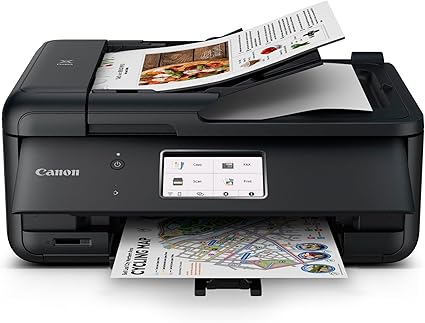
People who need a versatile home office printer with reliable document feeding will find this model fits well. Its biggest strength lies in the smooth integration with Alexa for ink monitoring and ordering, taking away a common printing hassle.
Setting up involves connecting wirelessly and linking with Alexa for voice commands and ink notifications. Day-to-day use works around the 20-sheet automatic document feeder for scanning and copying multiple pages.
Printing on various paper types is easy, including borderless 8.5 x 11 and square formats. The five individual ink tanks let you replace only the colors that run out, reducing waste.
Daily printing and scanning perform steadily at 15 pages per minute in black and color. The compact design sits solidly on a desk without taking up too much space.
Most praise points to smooth wireless printing and reliable duplex handling. Some users mention the 20-sheet ADF as a bit limited when handling large scanning jobs.
Voice-controlled notifications via Alexa for ink level and reorder simplify managing supplies. The 20-sheet automatic document feeder limits efficient scanning when dealing with long documents.
Ideal for users printing and scanning moderate volumes with smart ink management. Those with heavy scanning needs may want a larger capacity feeder printer.
Pros
- Alexa integration for ink management
- Auto 2-sided printing included
- Compact size with large paper capacity
- Five individual ink tanks save on replacements
Cons
- 20-sheet ADF may be small for heavy scanning tasks
- Print speed moderate for bulk jobs
| Specification | Details |
|---|---|
| Print Speed | 15 / 10 ipm |
| Document Feeder Capacity | 20-sheet ADF |
| Ink System | Five individual ink tanks |
| Paper Capacity | 200 Sheet (100 Cassette, 100 Rear Feed) |
| Dimensions (D x W x H) | 13.8″D x 17.3″W x 7.5″H |
| Wireless Printing | Yes |
9. Brother DCP-L2640DW Wireless Monochrome Multi-Function Printer

Perfect for small businesses needing high-speed black and white printing, this monochrome laser printer combines printing, scanning, and copying in one compact unit. Its standout feature is a 50-page auto document feeder that saves time when handling bulk scanning or copying tasks.
Setup is straightforward with support for wired Ethernet and dual-band wireless connections, making it easy to link laptops, smartphones, or tablets. Scanning multi-page documents is efficient thanks to the auto document feeder, and printing envelopes or labels adds practical versatility.
The flatbed scanner also comes in handy for delicate originals or smaller jobs.
Printing speeds reach up to 36 pages per minute, while scanning can hit nearly 24 images per minute for black and white documents. The build feels solid yet compact enough to fit a small office without taking up much space.
Most users appreciate the fast output but some note the limitation to monochrome prints and occasional issues with wireless setup.
Fast printing and a large auto document feeder make bulk jobs quick and efficient, which many find valuable. Some users experience challenges connecting the printer wirelessly, which can slow initial setup.
Small businesses needing dependable monochrome output and quick scanning will find this a good fit. Those requiring color printing or simpler connection setups may want to consider alternatives.
Pros
- Fast print speed of 36 ppm
- 50-page auto document feeder for multi-page jobs
- Supports wireless and Ethernet connections
- Compact size fits small office spaces
Cons
- Prints black and white only
- Occasional difficulty with wireless setup
| Specification | Details |
|---|---|
| Print Speed | 36 pages_per_minute |
| Scan Speed | 23.6/7.9 ipm (black/color) |
| Auto Document Feeder | 50 pages |
| Dimensions | 15.7″D x 16.1″W x 12.5″H |
| Weight | 25 pounds |
| Connection Options | Dual-band wireless (2.4GHz / 5GHz), Ethernet |
10. Epson EcoTank ET-4903 Wireless All-in-One Printer

Epson EcoTank ET-4903 Wireless All-in-One Printer stands out for its worry-free printing with huge ink capacity. Ideal for home offices or small businesses needing frequent color and black-and-white printing, it offers a reliable and cost-effective way to handle high print volumes without constant ink replacements.
Setup is straightforward, and the auto document feeder makes scanning and copying multiple pages simple. Refilling ink happens without mess thanks to large, clearly keyed tanks. Wireless connectivity supports smartphones, tablets, laptops, and PCs, which means printing fits well into day-to-day workflows across devices without fuss.
Print quality holds up well for both documents and occasional photos, with speeds up to 11 pages per minute in black-and-white. The build feels solid for an inkjet, and the footprint suits smaller spaces.
Most users appreciate the convenience of fewer ink changes, while some mention that color print speeds could feel a bit slow during heavy use.
The printer’s main praise acknowledges its large ink capacity that allows printing thousands of pages before refilling. This convenience minimizes interruptions during busy days. The most common drawback involves slower color printing speed, which might be noticeable when printing large color documents frequently.
Those who print high volumes in black-and-white or mixed color documents will find this model very convenient and affordable. It suits users prioritizing ink savings and wireless flexibility. People needing faster color output or support for specialty paper types might want to consider other options.
Pros
- Large ink tanks reduce need for frequent refills
- Auto document feeder speeds up scanning tasks
- Supports wireless printing from multiple devices
- Compact size fits well in small workspaces
Cons
- Color print speed slower than black and white
- Limited to plain paper media type
| Specification | Details |
|---|---|
| Printer Type | Inkjet |
| Printer Output Type | Color |
| Maximum Copy Speed Black and White | 11 pages_per_minute |
| Compatible Devices | Smartphones, Tablets, Laptops, PCs |
| Printer Dimensions (D x W x H) | 12.5″D x 14.8″W x 8.8″H |
| Item Weight | 12.1 pounds |
11. HP OfficeJet Pro 8125 Wireless All-in-One Printer

Easy to handle and reliable, the HP OfficeJet Pro 8125 fits well in home or small office spaces. It suits people needing quick color printing along with scanning and copying.
Its biggest strength lies in balancing speed and print quality on a flexible wireless setup.
Setup is straightforward with a touchscreen guiding through wireless connection to laptops and smartphones. Day-to-day, its quiet mode helps keep noise down during printing. The auto document feeder and 225-sheet input tray cut down the hassle of constantly loading paper, making scanning multiple pages or printing lengthy documents less of a chore.
Performance-wise, it prints color documents at a steady pace though color prints run slower than black at 10 ppm versus 20 ppm. Copy speed maxes out at 12 pages per minute. The build holds up well for a thermal inkjet but feels somewhat bulky at 17.6 pounds.
Users praise the professional-quality color output and dislike the limited one-sided ADF for scanning.
The printer delivers professional-level color prints and handles black-and-white pages quickly. Many appreciate the quiet printing mode and easy wireless setup. The biggest drawback is the auto document feeder only supports one-sided scanning, which can slow workflow for double-sided documents.
People needing fast, good-looking color prints with wireless convenience will find this well suited. Those who frequently scan double-sided pages or have tight desk space might want to look for a model with a duplex ADF or smaller footprint.
Pros
- Fast black and reliable color printing
- Large paper tray reduces refill frequency
- Wireless with touchscreen controls
- Quiet mode ideal for work environments
Cons
- Auto document feeder scans one side only
- Bulky design takes up space
| Specification | Details |
|---|---|
| Print Speeds (Black) | 20 ppm |
| Print Speeds (Color) | 10 ppm |
| Input Tray Capacity | 225 sheets |
| Scan Type | Flatbed; One-sided ADF |
| Connectivity | Wireless; Touchscreen |
| Weight | 17.6 pounds |
12. Epson Workforce Pro WF-4930 Wireless All-in-One Printer

Great for busy offices requiring quick, reliable printing, this all-in-one printer shines with its ability to handle high-volume jobs efficiently. Its standout feature is speed, thanks to PrecisionCore Heat-Free technology, making it ideal for workplaces where time matters most.
Setting up involves connecting wirelessly, which is straightforward, and the touchscreen eases navigation through menus. The 50-sheet Auto Document Feeder and duplex functions simplify scanning and copying double-sided documents regularly used. Managing paper is easier with two 250-sheet trays plus a 500-sheet capacity, reducing the need for frequent refills on heavy print days.
Printing quality is sharp due to accurate dot placement and DURABrite Ultra pigment inks. It handles 25 black and 12 color pages per minute, maintaining consistency without overheating thanks to heat-free tech.
The design feels sturdy but a bit bulky at 23.6 pounds, yet it’s built to last for heavy workloads. Most praise is for its speed and reliability, while some point out the high ink cost as a downside.
High praise highlights the printer’s speed and durable performance during heavy printing tasks. The most frequent complaint concerns the expense of ink cartridges, which can be a consideration for long-term costs.
Offices needing fast, frequent print jobs will appreciate this model’s capabilities. Those with limited space or lower printing volumes might want to explore smaller or more economical alternatives.
Pros
- Fast printing speed for busy offices
- Reliable duplex scanning and copying
- Large paper capacity reduces refills
- Clear touchscreen for easy controls
Cons
- Ink costs can add up quickly
- Larger size takes up more desk space
| Specification | Details |
|---|---|
| Printer Type | Inkjet |
| Print Speed | 25 ppm black, 12 ppm color |
| Paper Capacity | 500 sheets (two 250-sheet trays) |
| Auto Document Feeder | 50 sheets |
| Scanner Type | Flatbed, Sheetfed |
| Item Weight | 23.6 pounds |
13. Brother MFC-L5915DW Wireless Monochrome Laser All-in-One Printer
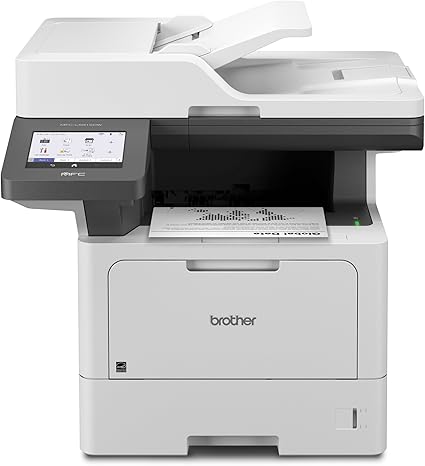
Constructed around a solid monochrome laser design, the Brother MFC-L5915DW fits well in busy office environments where speed and reliability are key. It stands out for high-speed printing at 50 pages per minute, making it ideal for users with heavy daily print and copy demands.
Setup is straightforward, especially with the 5 color touchscreen guiding through menus and wireless connections. The 70-page auto document feeder scans double-sided documents quickly, helping keep workflow moving without constant intervention. Printing directly from smartphones, tablets, or USB flash drives works smoothly, alleviating some common bottlenecks in shared office setups.
Print quality remains sharp and professional, consistent with laser standards, while the large document glass accommodates legal-sized scanning tasks easily. The machine feels solid and weighs in at over 38 pounds, giving a sense of durability but requiring a stable placement. Fast scanning speeds and large toner capacity receive praise, though some mention the size and weight could challenge small workspaces.
The printer delivers rapid, crisp prints with a large-capacity ADF that suits heavy office demands. It is commonly noted that the unit’s weight and size require a dedicated, stable spot that may not fit in smaller spaces.
Ideal for offices needing fast, reliable black-and-white output and efficient scanning of multiple pages. People looking for color printing or a lighter, smaller machine should consider alternative models better suited to those requirements.
Pros
- Fast monochrome printing speed of up to 50 pages per minute
- 70-page capacity auto document feeder
- 5″ touchscreen for easy navigation
- Ultra high-yield 18,000-page toner cartridge option
Cons
- Weighs over 38 pounds, taking up desk space
- Monochrome output limits color printing needs
| Specification | Details |
|---|---|
| Printer Type | Laser |
| Print and Copy Speed | Up to 50ppm |
| Auto Document Feeder Capacity | 70 pages |
| Scanner Speed | Up to 56ipm two-sided |
| Item Weight | 38.3 pounds |
| Item Dimensions (D x W x H) | 18.6″ x 19.5″ x 19.1″ |
14. Epson EcoTank Pro ET-5180 Wireless Color All-in-One Printer

Wireless color printing combined with an ink tank system makes the Epson EcoTank Pro ET-5180 ideal for busy offices needing high-volume output without constant ink changes. It stands out for its refillable ink tanks that keep running costs low while handling large copying tasks smoothly.
Setting it up is straightforward, and connecting via Wi-Fi works well with laptops. The refillable ink tanks mean you rarely worry about replacing cartridges, saving time and money.
The sheetfed scanner fits nicely for document feeder tasks, and it handles various media from envelopes to glossy photo paper easily during everyday use.
Print speed reaches up to 40 black-and-white pages per minute, making it quite efficient. It weighs 16.1 pounds and measures 13.7D x 14.8W x 13.6H, so it fits comfortably on office desks.
Most praise the low ink costs and clear color output, while some users mention the occasional learning curve with the Android controller interface.
Low ink costs combined with high copying speed impress users the most. Some find the Android controller interface a bit challenging initially. The broad media support also fits diverse printing needs.
Anyone needing high-volume, cost-efficient color printing with a document feeder will appreciate this model. Those looking for a more traditional or simpler control system might want to consider alternatives.
Pros
- Refillable ink tanks reduce running costs substantially
- Handles various print media types
- Sheetfed scanner supports document feeding tasks
- Fast black and white copy speed
Cons
- Android controller can take time to get used to
- Limited to working mainly with laptops
| Specification | Details |
|---|---|
| Printer Type | Inkjet |
| Print media | Envelopes, Glossy photo paper, High-resolution paper, Labels, Paper (plain) |
| Scanner Type | Sheetfed |
| Maximum Copy Speed Black and White | 40 pages_per_minute |
| Item Weight | 16.1 pounds |
| Controller Type | Android |
15. Brother MFC-J480DW Wireless Inkjet All-in-One Printer

Perfect for anyone needing a compact, wireless all-in-one printer, it stands out for its reliable wireless printing capabilities. It suits small office setups or home users who want convenience and decent color output from their inkjet printer combined with a document feeder scanner.
Setup involves unpacking and connecting through a smartphone app for wireless control, which keeps the workspace clutter-free. Its single paper tray and sheetfed scanner simplify daily copy and scan tasks. The LCD display lets you control functions directly, so you don’t have to use the app every time, making daily use simple and easy.
Prints in color with a maximum black-and-white copy speed of 6 pages per minute, handling typical document loads without fuss. The build is solid, weighing 8 kg and compact in size, fitting comfortably on a desk. Strong points include reliable wireless performance, while some might find the resolution of 203 x 203 DPI a bit low for detailed images.
The wireless printing feature reliably connects with smartphones, making daily printing convenient. A common drawback is the relatively low print resolution, which might impact image sharpness on finer tasks.
Those who value wireless ease and use primarily documents or casual color prints will find this model useful. Users with high-resolution printing needs or faster copy requirements might consider other options.
Pros
- Compact size fits small spaces easily
- Wireless control via smartphone app
- All-in-one functionality for printing, scanning, copying
- Works well with smartphones
Cons
- Print resolution is relatively low at 203 x 203 DPI
- Copy speed limited to 6 pages per minute
| Specification | Details |
|---|---|
| Printer Type | Inkjet |
| Wireless Printing | Yes |
| Maximum Copy Speed Black and White | 6 pages_per_minute |
| Scanner Type | Sheetfed |
| Weight | 8 kg |
| Resolution | 203 x 203 DPI |
Best Document Feeder Printers Comparison Table
| Product | Printer Type | Auto-Duplex | Printer Output Type | Item Weight |
|---|---|---|---|---|
| Canon PIXMA TR4720 | Inkjet | Yes | Color | – |
| Brother INKvestment J5010DW | Inkjet | Yes | Color | 30.9 pounds |
| Canon imageCLASS D1620 | Laser | Yes | Monochrome | 41.9 pounds |
| HP OfficeJet Pro 9025 | Inkjet | Yes | Color | – |
| Canon PIXMA TR7120 | Inkjet | Yes | Color | 18.1 pounds |
| Brother Work Smart 1360 | Inkjet | Yes | Color | 16.8 pounds |
| Canon MegaTank MAXIFY GX2020 | Inkjet | – | Color | 17.8 pounds |
| Canon PIXMA TR8620a | Inkjet | – | Color | 17.4 pounds |
| Brother DCP-L2640DW | Laser | Yes | Monochrome | 25 pounds |
| Epson EcoTank ET-4903 | Inkjet | – | Color | 12.1 pounds |
| HP OfficeJet Pro 8125 | HP Thermal Inkjet | – | Color | 17.6 pounds |
| Epson Workforce Pro WF-4930 | Inkjet | Yes | Color | 23.6 pounds |
| Brother MFC-L5915DW | Laser | – | Monochrome | 38.3 pounds |
| Epson EcoTank Pro ET-5180 | Inkjet | – | Color | 16.1 pounds |
| Brother MFC-J480DW | Inkjet | – | Color | 8 kg |
- Printer TypeInkjet
- Auto-DuplexYes
- Printer Output TypeColor
- Item Weight–
- Printer TypeInkjet
- Auto-DuplexYes
- Printer Output TypeColor
- Item Weight30.9 pounds
- Printer TypeLaser
- Auto-DuplexYes
- Printer Output TypeMonochrome
- Item Weight41.9 pounds
- Printer TypeInkjet
- Auto-DuplexYes
- Printer Output TypeColor
- Item Weight–
- Printer TypeInkjet
- Auto-DuplexYes
- Printer Output TypeColor
- Item Weight18.1 pounds
- Printer TypeInkjet
- Auto-DuplexYes
- Printer Output TypeColor
- Item Weight16.8 pounds
- Printer TypeInkjet
- Auto-Duplex–
- Printer Output TypeColor
- Item Weight17.8 pounds
- Printer TypeInkjet
- Auto-Duplex–
- Printer Output TypeColor
- Item Weight17.4 pounds
- Printer TypeLaser
- Auto-DuplexYes
- Printer Output TypeMonochrome
- Item Weight25 pounds
- Printer TypeInkjet
- Auto-Duplex–
- Printer Output TypeColor
- Item Weight12.1 pounds
- Printer TypeHP Thermal Inkjet
- Auto-Duplex–
- Printer Output TypeColor
- Item Weight17.6 pounds
- Printer TypeInkjet
- Auto-DuplexYes
- Printer Output TypeColor
- Item Weight23.6 pounds
- Printer TypeLaser
- Auto-Duplex–
- Printer Output TypeMonochrome
- Item Weight38.3 pounds
- Printer TypeInkjet
- Auto-Duplex–
- Printer Output TypeColor
- Item Weight16.1 pounds
- Printer TypeInkjet
- Auto-Duplex–
- Printer Output TypeColor
- Item Weight8 kg
How to Choose the Right Document Feeder Printer
Choosing a document feeder printer depends on factors like scanning speed, paper capacity, and compatibility with your devices. Prioritizing these ensures efficient handling of large tasks and reduces jams or errors, ultimately saving time and avoiding costly repairs or replacements.
Document Feeder Capacity
Document feeders vary widely in how many sheets they can hold before needing a reload. Small models might hold a handful of pages, which quickly becomes frustrating during large tasks, while others can manage 50 to 100 pages at once.
A larger capacity reduces interruptions and keeps workflow steady. Mixed media handling matters for routine tasks involving envelopes, labels, or thick paper. Poorly equipped feeders often cause jams or misfeeds when the papers aren’t uniform, which kills efficiency.
Speed is also crucial. Slow feeding makes waiting experience tedious, especially when the machine struggles to pull multiple sheets constantly. Look for feeders with separation and ultrasonic sensors that minimize double feeds and jams.
A good feeder runs smoothly around 20-30 pages per minute without hiccups, handling a variety of sizes from standard letter to legal without frequent adjustments.
Print Quality and Speed
Printed pages often become difficult to distinguish when resolutions and speeds are low. Standard resolution (around 1200 x 1200 dpi) delivers crisp text and detailed images that stay consistent across documents. Printers with lower resolutions tend to produce blurry or faint text, which looks unprofessional and can be hard to read, especially for small fonts or fine lines.
Speed affects daily productivity. Average machines print 20 to 40 pages per minute, which suits most office routines. Speeds fluctuate with color jobs or high-resolution images, so machines claiming fast ppm should maintain quality over time, not just on the first few pages.
Consistency during long print runs means the printer doesn’t slow down notably or swap quality for speed.
Connectivity and Compatibility
Connection options influence where and how you print or scan. USB remains standard but wireless and Ethernet support have become essential for modern setups.
Wireless access points allow printing from multiple devices without cables, ideal for shared office environments. Failures or complex setups in these connections lead to wasted time and stress.
Compatibility with operating systems such as Windows, MacOS, and popular Linux distros ensures that no matter your device, printing remains straightforward. Smartphone or tablet printing via Wi-Fi Direct or apps like AirPrint and Google Cloud Print offers flexibility, removing the need for a PC. Without reliable mobile capabilities, you may face frequent workarounds or transfers just to print or scan documents.
Ease of Use and Maintenance
Printers with clear, well-labeled controls reduce mistakes and speed learning. Touchscreens or simple button layouts allowing quick mode changes help avoid frustrating trial and error.
Opening trays and compartments for replacing ink or toner should require minimal effort and no special tools because frequent replacements are part of daily use.
Clearing paper jams can become a major headache if the feeder design doesn’t provide easy access paths. Locations where jams often occur should open without disassembling multiple parts. Routine cleaning processes for rollers and sensors also need to be straightforward to ensure smooth operation over time, preventing unexpected downtime.
Durability and Build Quality
Devices intended for regular use need sturdy construction to hold up under stress. Feeders made from durable plastics or metal components resist bending or breaking after hundreds of page loads. Cheaper models often fail in moving parts like rollers or feeders, causing jams and costly repairs.
Reliability comes down to how well the mechanical parts handle wear and tear. Models with quality bearings and well-maintained feeder paths prevent frequent service calls or replacements. A solid warranty and accessible customer support provide a safety net, ensuring repairs or replacements don’t become a burden during heavy use periods.
How to Optimize Your Printer’s Document Feeder for Efficient Workflow
Loading the document feeder correctly prevents paper jams and keeps your workflow steady. Align pages neatly, ensuring they are not bent or stuck together. Most feeders have adjustable guides, set them snugly against the stack to avoid misfeeds.
Keep an eye on the feeder’s maximum sheet capacity to avoid overloading, which often causes jams and misfeeds.
Regularly clean the feed rollers with a lint-free cloth slightly dampened with water or a mild cleaner. Dust and paper debris can accumulate, making the rollers less effective over time.
Feeding single-sided documents face-up lets the printer scan in the proper order, reducing rescanning and delays.
- Use good-quality paper to reduce static and sticking issues.
- Keep the scanner bed closed during feeding to prevent damage.
- Periodically test the feeder with different document sizes to ensure it adjusts correctly.
Common Maintenance Practices to Extend the Lifespan of Your Document Feeder Printer
Routine care extends the document feeder’s life and maintains print quality. Clearing paper dust and debris after heavy use reduces wear on the roller components. Use compressed air to blow out particles lodged inside the feeder mechanism.
Lubricate moving parts only if recommended by your printer’s manufacturer, using approved substances. Avoid forcing paper jams as this can damage internal components. Instead, gently remove stuck sheets by opening accessible panels and carefully pulling the paper out along the feeder path.
- Replace worn feed rollers promptly to maintain smooth sheet feeding.
- Update printer firmware regularly; some include feeder performance improvements.
- Keep the printer in a dust-free environment and avoid exposure to humidity, which can cause paper to stick.
People Also Asked
How Do I Maintain a Document Feeder Printer Properly?
Regular cleaning of the rollers and scanning glass is important for maintaining a document feeder printer. Using a soft cloth and manufacturer-recommended cleaner prevents paper jams and scanning errors. Avoid using harsh chemicals that can damage components.
What Size Documents Can a Document Feeder Printer Handle?
Document feeder printers commonly handle standard letter and legal-sized documents, typically ranging from 4×6 inches to 8.5×14 inches. Some models can process smaller receipts or larger sizes, but it is best to check the specifications for exact supported dimensions.
Is a Document Feeder Printer Safe to Use Daily?
Document feeder printers are generally safe to use daily when handled properly. Consistent maintenance like keeping the feeder free from dust and paper debris helps avoid issues. Do not overload the feeder beyond its maximum sheet capacity to prevent jams.
Which Devices Are Compatible with a Document Feeder Printer?
Most document feeder printers work with computers running Windows, macOS, and some support mobile devices through Wi-Fi or USB connections. Drivers usually come with the printer or are downloadable from the manufacturer’s site to ensure smooth compatibility.
How Long Does a Typical Document Feeder Printer Last?
A typical document feeder printer lasts around 3 to 5 years with regular use and proper care. Usage frequency, maintenance, and part replacements like rollers affect longevity. Replacing consumables according to the manufacturer’s schedule helps keep it running longer.
Conclusion
Choosing the right document feeder printer mostly depends on how many pages you need to scan or copy regularly, the speed at which it can process those pages, and whether it supports the scan quality and connectivity options you require. Durable construction matters too, especially if you expect heavy use over time.
Consider the space where you plan to keep the printer and your budget before deciding. Devices that fit small desks might have fewer features. Check the comparison table and detailed picks above to find the model that fits your daily workload and space best.
