Which Birds Murmurate: Understanding Birds That Fly in Unison
Murmurations are one of nature’s most mesmerizing spectacles, where hundreds or thousands of birds move together in synchronized patterns across the sky. Watching this phenomenon gives you a glimpse into the incredible coordination and communication among birds. Understanding which birds murmurate helps you identify the species that perform these stunning aerial displays.
Typically, smaller birds that travel in large flocks exhibit this behavior, often during migration or while roosting. The patterns are not random—they are carefully coordinated movements that protect the flock from predators, conserve warmth, and enhance navigation. By observing these groups, you notice how every individual bird reacts instantly to its neighbors, creating fluid, ever-changing shapes that seem almost choreographed. Learning about which birds murmurate allows you to appreciate both the beauty and the complex social behavior behind these breathtaking displays, revealing the intelligence and instinct that guide their movements.
Common Birds That Murmurate
Murmurations are incredible aerial displays where thousands of birds move in seamless, coordinated patterns. Observing these formations allows you to understand how birds communicate and respond to each other in real time. Common birds that murmurate are often smaller, social species that gather in large flocks for protection and warmth. Their synchronized movements are not only mesmerizing but serve practical purposes, like confusing predators and maintaining group cohesion. Watching these birds in action highlights both their intelligence and instinctive behaviors.
Starlings
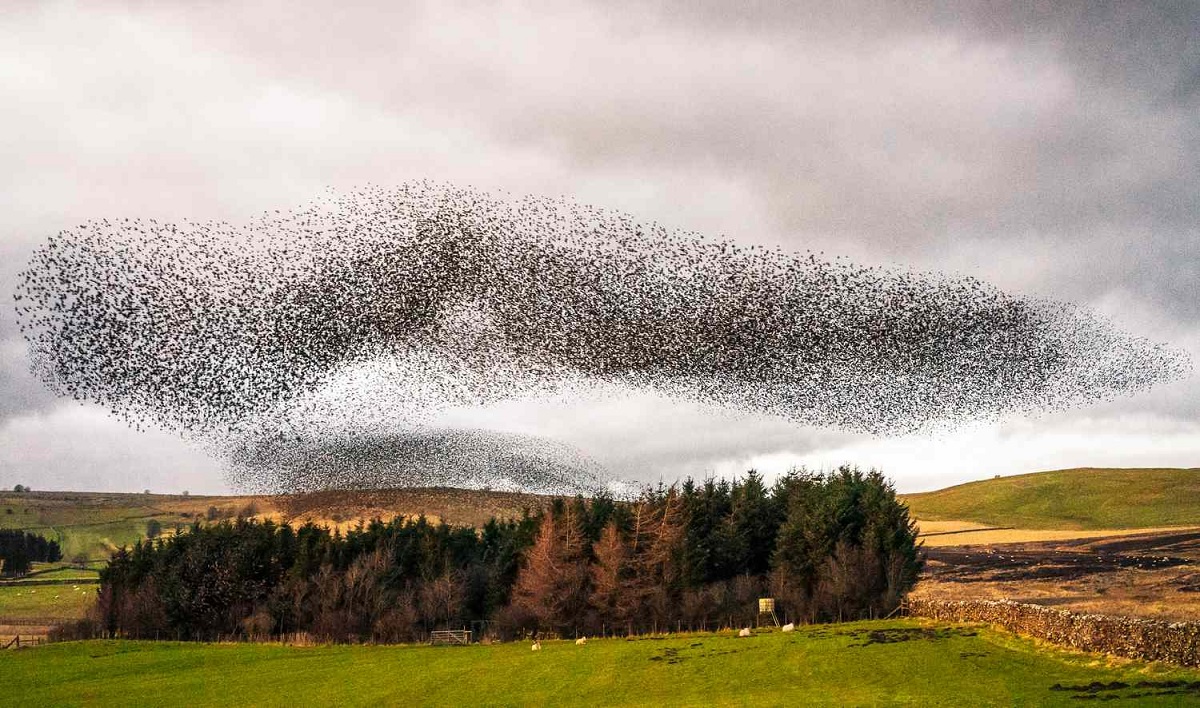
Starlings are the most famous birds known for murmurations. These small, dark-feathered birds gather in massive flocks, sometimes numbering in the tens of thousands, creating spectacular patterns in the sky. You notice how their movements are almost choreographed, with each bird responding to the subtle shifts of its neighbors. The flock moves as a single entity, forming twisting, flowing shapes that seem to ripple across the horizon.
Murmurations provide starlings with safety in numbers. When predators like hawks or falcons approach, the flock’s dynamic shape makes it extremely difficult for a single bird to be targeted. Beyond protection, these formations help starlings stay warm during colder months and maintain social bonds within the group. You can see how each bird’s awareness and quick reactions create a stunning visual display that is both practical and mesmerizing. Starlings’ ability to murmurate demonstrates remarkable coordination, making them one of the most celebrated examples of this natural phenomenon.
Red-winged Blackbirds
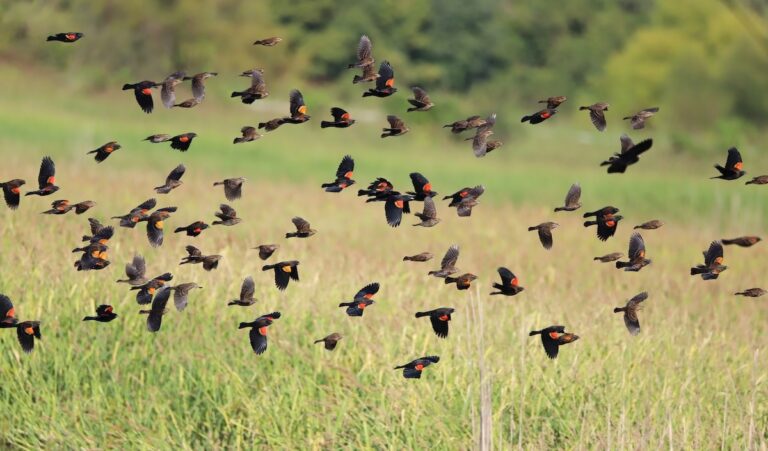
Red-winged blackbirds are another species that frequently engage in murmurations, especially during migration and around communal roosts. Their murmurations may be smaller than those of starlings, but they still create captivating aerial displays as hundreds or thousands of birds move together. These synchronized flights help them avoid predators and navigate across open fields and wetlands.
You notice how the blackbirds shift direction almost instantaneously, creating fluid, wave-like patterns. These movements are not random; they reflect a high level of social coordination, with each bird reacting to the motions of nearby flock members. Murmurations also reinforce group cohesion and communication, allowing the birds to share information about food sources and roosting spots. Red-winged blackbirds highlight how murmurations are not exclusive to starlings but are a shared behavior among highly social bird species. Observing these blackbirds offers insight into the intelligence and adaptability required for coordinated group flight.
European Robins and Other Species
While starlings and red-winged blackbirds are the most well-known, other species like European robins, blackbirds, and grackles occasionally form smaller murmurations. These gatherings usually occur around feeding sites or roosting areas, creating striking patterns in the sky even if the flocks are smaller. Each bird’s movement is influenced by its neighbors, resulting in fluid, coordinated displays.
These murmurations provide similar benefits as larger flocks: safety from predators, warmth during colder months, and social interaction. Even smaller murmurating flocks demonstrate the sophisticated communication and reflexive responses needed to maintain cohesion. Watching these species in action emphasizes that murmurations are a versatile behavior found across multiple bird types. They reveal not only the beauty of synchronized flight but also the underlying instincts that ensure survival and social cooperation within the flock.
Other Birds That Murmurate
Murmurations are not exclusive to starlings or blackbirds; several other bird species display this remarkable behavior, often in smaller or less frequent flocks. Observing other birds that murmurate allows you to appreciate the diversity of this phenomenon across different environments and habitats. These displays serve the same core purposes: protection from predators, social bonding, and coordination during migration or roosting. Watching these birds move together highlights how instinct, communication, and group awareness create mesmerizing aerial patterns.
Grackles
Grackles are known for forming large, synchronized flocks, particularly during the evening as they gather at roosting sites. Their murmurations can include hundreds or even thousands of individuals, creating intricate, flowing patterns in the sky. You notice how the birds shift direction almost instantaneously, responding to the subtle movements of nearby flock members. These rapid changes make it extremely difficult for predators to single out one bird, providing safety in numbers.
Grackles’ social behavior is evident during these displays. The murmurations allow them to communicate about roosting locations, feeding grounds, and potential threats. Their coordinated flight demonstrates remarkable awareness and reflexes, as each bird adjusts its position based on its neighbors. Even in smaller flocks, grackles’ murmurations are mesmerizing, showcasing the combination of instinct, coordination, and social interaction that drives these aerial dances. Observing grackles highlights that murmurating behavior extends beyond the most famous species, revealing the adaptability of flocking behaviors in different bird types.
Common Blackbirds
Common blackbirds occasionally form murmurations, particularly in colder months when they gather in large numbers near feeding or roosting areas. While these murmurations are smaller than those of starlings, they are equally captivating, with fluid, wave-like movements sweeping across the sky. Each bird’s movement is influenced by the position and speed of its neighbors, creating intricate patterns that appear almost choreographed.
These aerial displays provide safety from predators, as the dense, shifting formations make it difficult for any single bird to be targeted. The murmurations also strengthen social bonds and facilitate communication within the group, allowing birds to coordinate roosting locations and alert each other to potential threats. Observing blackbirds in flight reveals how even less conspicuous species rely on group behavior to survive. Their murmurations demonstrate that coordinated movement is a widespread adaptation, supporting survival, social interaction, and efficiency in navigating their environment.
European Starlings vs. Other Species
European starlings are the most iconic murmuration performers, but observing other species helps you understand how widespread and versatile this behavior is. Birds such as grackles, blackbirds, and even some finches engage in similar synchronized flight patterns. These birds may form smaller flocks, but the principles of coordination, reflexive movement, and social awareness remain the same.
Watching these other birds murmurate shows how instinct and communication are crucial in group flight. The birds respond instantly to their neighbors’ positions, creating fluid and ever-changing shapes in the sky. These displays provide protection, enhance social interaction, and help birds conserve energy during movement. By studying a variety of species, you gain a fuller picture of how murmurations are an adaptive strategy for many birds, not just the most famous examples.
Other Birds That Murmurate
While starlings and red-winged blackbirds are the most famous for murmurations, other bird species also exhibit this fascinating behavior. Observing other birds that murmurate helps you understand how widespread this survival strategy is across different habitats and climates. These aerial displays are more than just beautiful—they protect the flock from predators, facilitate social interaction, and aid in navigation during migration. Watching these species move in synchronized patterns highlights the instinct, coordination, and awareness necessary for such complex behavior.
European Robins
European robins occasionally form smaller murmurations, particularly when they gather near feeding sites or roosts during colder months. Unlike starlings, their flocks are usually more modest in size, but the movements are still fluid and coordinated. You notice how each bird adjusts its flight path according to its neighbors, producing intricate wave-like patterns in the sky.
These displays serve multiple purposes. They help robins stay safe from predators by creating confusion, and they also facilitate social interaction within the group. Murmurations allow birds to share information about food sources or roosting locations while conserving energy through collective movement. Even though robin murmurations are less dramatic, they demonstrate that synchronized flight is not exclusive to large, densely packed flocks. Watching these birds offers insight into the subtle ways smaller species use collective behavior to survive and thrive in their environments.
Grackles
Grackles are social birds that form large murmurating flocks, especially near communal roosting sites. Their displays can involve hundreds or even thousands of birds, creating dynamic, shifting patterns in the evening sky. You notice how quickly the flock changes direction, with each individual responding almost instantly to the movements of its neighbors.
These murmurations serve multiple practical purposes. The large, coordinated groups provide safety against predators, making it difficult for a hawk or falcon to single out one bird. Additionally, the aerial displays help grackles reinforce social bonds, share information about food sources, and coordinate communal roosting sites. Their murmurations demonstrate that even outside of starlings, birds can achieve remarkable levels of coordination and collective intelligence. Observing grackles reveals the versatility of murmurating behavior across different species and habitats.
Common Blackbirds
Common blackbirds sometimes gather in smaller murmurating flocks, particularly in areas with abundant winter food or during roosting migrations. These flocks, while smaller than starling murmurations, still form fluid, wave-like movements that are captivating to watch. Each bird reacts quickly to its neighbors, maintaining cohesion and synchronization throughout the flight.
These coordinated movements serve as protection, making it harder for predators to target any individual bird. Murmurations also strengthen social bonds, allowing blackbirds to communicate indirectly about feeding areas or roosting spots. Watching blackbirds engage in synchronized flight highlights that murmurating behavior is a practical survival strategy, not just a visual spectacle. Even smaller flocks demonstrate impressive teamwork and coordination, showing how instinctive reactions and collective awareness are essential for group-living species.
European Finches
European finches occasionally engage in murmurations, particularly during migration or around communal feeding areas. Their flocks are smaller compared to starlings, but the same principles of synchronized movement apply. Each bird constantly adjusts to its neighbors, producing rapid, flowing aerial patterns.
These murmurations provide protection against predators and help maintain group cohesion during long migrations. Finches use the displays to communicate indirectly about food sources or safe resting areas. Observing finches highlights how even smaller, less conspicuous species have evolved the ability to coordinate in flight. Their murmurations show that this behavior is not limited to large, dense flocks but can occur across a range of species with varying social and environmental needs.
Swallows
Swallows are known for their acrobatic flight and occasionally form murmurating flocks, especially during migration or when preparing to roost. Their flocks are fluid and fast-moving, with individual birds weaving intricately around each other.
The synchronized movements protect the group from predators while allowing swallows to scout for food collectively. These murmurations also improve aerodynamic efficiency, enabling the birds to conserve energy during long flights. Watching swallows demonstrates that murmurating behavior can occur even in species that spend most of their time in open skies, showing the wide adaptability of this fascinating behavior across various bird types.
Murmuration and Bird Behavior
Murmurations are not just visually stunning—they reveal a lot about bird behavior, social structure, and survival strategies. Observing these aerial formations allows you to understand how birds communicate, coordinate, and respond to threats in real time. The way birds move together reflects instincts, learning, and group dynamics that have evolved over thousands of years. By studying murmuration and bird behavior, you gain insight into the intelligence, reflexes, and adaptability that allow birds to thrive in diverse environments while maintaining cohesion within large flocks.
Social Coordination and Communication
Murmurations highlight the importance of social coordination in birds. Each individual continuously monitors the movements of its neighbors, adjusting its speed and direction almost instantaneously to maintain harmony within the flock. You can see how this real-time response demonstrates a high level of communication, even without vocal signals. The behavior allows birds to remain together, share information about food sources, and alert one another to potential predators.
The ability to move collectively also reflects learned behaviors and instinctive responses. Birds within a murmuration develop a sense of spatial awareness, ensuring the flock functions as a cohesive unit. These coordinated movements are essential for maintaining safety, as large groups confuse predators and reduce the likelihood of any single bird being targeted. By observing these patterns, you notice how social behavior and coordination are central to flock survival and efficiency in both foraging and migration.
Predator Avoidance and Safety
Murmurations serve a crucial role in predator avoidance. The constantly shifting shapes and rapid, synchronized movements make it difficult for predators such as hawks or falcons to single out one bird. You notice how the flock appears almost fluid, with gaps closing instantly as birds react to changes in direction. This unpredictability is a natural defense mechanism that reduces predation risk.
In addition to confusing predators, murmuration behavior enhances vigilance. Each bird contributes to detecting potential threats while staying connected to the group. The collective awareness means that warning signals are transmitted through subtle movements, allowing rapid and coordinated escape responses. Studying this aspect of murmuration and bird behavior shows how instinctive and adaptive these patterns are. They provide a remarkable example of how natural selection has shaped behavior to optimize safety in large, dynamic groups.
Energy Efficiency and Navigation
Murmurations also contribute to energy efficiency and navigation during movement. Birds flying in large, coordinated flocks can take advantage of aerodynamic benefits, such as reduced wind resistance, similar to how cyclists draft in groups. You notice how each bird positions itself to maximize airflow and conserve energy during long flights or migrations.
These coordinated movements also aid in navigation, as individuals follow the flock while staying alert to landmarks and environmental cues. Birds rely on collective decision-making to find optimal routes, avoid obstacles, and locate resources like food or roosting sites. Murmuration and bird behavior are closely linked in these processes, as social coordination enhances efficiency, reduces fatigue, and increases the chances of survival. By studying these interactions, you gain insight into the intelligence and adaptability that allow birds to thrive in complex environments.
Frequently Asked Questions
Which Birds Are Known To Murmurate?
Starlings are the most famous birds that murmurate, forming large flocks that create mesmerizing patterns in the sky. Red-winged blackbirds, grackles, and European robins also exhibit murmurations, though often in smaller groups. You notice that these birds tend to be social and gather in large numbers for safety and communication. Murmurating behavior helps them coordinate movements, avoid predators, and strengthen social bonds. Watching which birds murmurate allows you to appreciate how instinct and group dynamics create stunning aerial displays while serving practical purposes like protection and navigation.
Why Do Birds Murmurate?
Birds murmurate to stay safe, communicate, and navigate effectively. The coordinated movements confuse predators, making it hard for them to target a single bird. Murmurations also help birds maintain social cohesion, as each individual adjusts its flight based on nearby flock members. You can see how this behavior allows the group to share information about food or roosting spots. Additionally, flying in a synchronized flock improves energy efficiency during long flights. Murmurating behavior combines instinct, coordination, and survival strategy, showing how birds rely on both individual awareness and collective action.
When Do Birds Typically Murmurate?
Birds typically murmurate during evening gatherings before roosting or during migration periods. You notice that starlings often form large murmurations at dusk, creating fluid aerial displays before settling for the night. Smaller species may murmurate around feeding sites or communal roosts. The timing of these behaviors is linked to predator avoidance, social interaction, and energy conservation. Observing when birds murmurate helps you understand their daily routines and survival strategies. These specific times maximize the benefits of safety, warmth, and communication, demonstrating the practical role of synchronized flight in their behavior.
How Do Birds Coordinate Murmurations?
Birds coordinate murmurations through real-time visual cues and instinctive responses. Each bird monitors its nearest neighbors, adjusting speed and direction instantly to maintain the flock’s cohesion. You notice how even subtle movements ripple across the flock, creating fluid, wave-like patterns. This coordination does not require vocal signals; instead, it relies on rapid perception and reaction. The ability to respond collectively allows birds to avoid collisions, stay safe from predators, and navigate efficiently. Studying how birds murmurate shows the sophistication of group behavior and the complex interactions that govern synchronized flight.
Are Murmurations Exclusive To Starlings?
Murmurations are not exclusive to starlings, though they are the most famous example. Other birds such as red-winged blackbirds, grackles, European robins, and even finches occasionally display murmurating behavior. These species form coordinated flocks to gain the same benefits: predator avoidance, social cohesion, and efficient navigation. You notice that while the size and complexity of the flocks may differ, the underlying behavior is similar across species. Observing these other birds shows that murmurations are a versatile and adaptive behavior, used by multiple social species to enhance survival in varied environments.
What Benefits Do Birds Gain From Murmurating?
Birds gain several benefits from murmurating, including protection from predators, social bonding, and improved navigation. Large, coordinated flocks make it difficult for predators to single out one bird, increasing the safety of the group. Murmurations also allow birds to communicate about food, roosting locations, and environmental hazards. Additionally, flying in synchronized formations can reduce energy expenditure, as birds take advantage of aerodynamic effects from nearby flock members. You can see that murmurating behavior is both a survival strategy and a social tool, highlighting the intelligence and instinctive coordination of birds in the wild.
Final Thoughts
Observing the graceful movements of murmurating birds offers a fascinating glimpse into the natural world and the intelligence of avian species. Birds that participate in murmuration do so for multiple reasons, including protection from predators, efficient communication, and social bonding within the flock. Among these, starlings are the most well-known, forming massive, fluid formations that can change shape in an instant, while other species like sparrows and blackbirds also exhibit similar behaviors under certain conditions.
Understanding these patterns helps birdwatchers and researchers appreciate the complexity of avian life and the ways different species interact with their environment. By studying which birds murmurate, we gain insight into their survival strategies, migratory habits, and communal instincts, highlighting how coordinated movement in nature can be both functional and mesmerizing. Murmuration remains one of the most captivating natural phenomena to witness and study.